Τρίτη 17 Νοεμβρίου 2020

The X-linked intellectual disability gene product and E3 ubiquitin ligase KLHL15 degrades doublecortin proteins to constrain neuronal dendritogenesis [Molecular Bases of Disease]

Alexandros G.Sfakianakis shared this article with you from Inoreader

JBC_twittercard.png

Proper brain development and function requires finely controlled mechanisms for protein turnover and disruption of genes involved in proteostasis is a common cause of neurodevelopmental disorders. Kelch-like 15 (KLHL15) is a substrate adaptor for cullin3 (Cul3)-containing E3 ubiquitin ligases and KLHL15 gene mutations were recently described as a cause of severe X-linked intellectual disability (XLID). Her e, we used a bioinformatics approach to identify a family of neuronal microtubule-associated proteins (MAPs) as KLHL15 substrates, which are themselves critical for early brain development. We biochemically validated doublecortin (DCX), also an X-linked disease protein, and doublecortin-like kinase 1 and 2 (DCLK1/2) as bona fide KLHL15 interactors and mapped KLHL15 interaction regions to their tandem DCX domains. Shared with two previously identified KLHL15 substrates, a FRY tripeptide at the C-terminal edge of the second DCX domain is necessary for KLHL15-mediated ubiquitination of DCX and DCLK1/2 and subsequent proteasomal degradation. Conversely, silencing endogenous KLHL15 markedly stabilizes these DCX domain-containing proteins and prolongs their half-life. Functionally, overexpression of KLHL15 in the presence of wild-type DCX reduces dendritic complexity of cultured hippocampal neurons, whereas neurons expressing FRY-mutant DCX are resistant to KLHL15. Collectively, our findi ngs highlight the critical importance of the E3 ubiquitin ligase adaptor KLHL15 in proteostasis of neuronal MAPs and identify a regulatory network important for development of the mammalian nervous system.
View on the web

Calmodulin binds and modulates K+-dependent Na+/Ca2+-exchanger isoform 4, NCKX4. [Cell Biology]

Alexandros G.Sfakianakis shared this article with you from Inoreader

JBC_twittercard.png

The family of K+-dependent Na+/Ca2+-exchangers, NCKX, are important mediators of cellular Ca2+ efflux, particularly in neurons associated with sensory transduction. The NCKX family comprises five proteins, NCKX1–5, each the product of a different SLC24 gene. NCKX4 (SLC24A4) has been found to have a critical role in termination and adaptation of visual and olfactory signals, melanocortin-dependent satiety signaling, and the maturation of dental enamel. To explore mechanisms that might influence the temporal control of NCKX4 activity, a yeast two-hybrid system was used to search for protein interaction partners. We identified calmodulin as a partner for NCKX4, and confirmed the interaction using glutathione-S-transferase-fusion-pulldown. Calmodulin binding to NCKX4 was demonstrated in extracts from mouse brain and in transfected HEK293 cells. Calmodulin bound in a Ca2+-dependent manner to a motif present in the central cytosolic loop of NCKX4, and was abolished by the double mutant I328D/F334D. When co-transfected in HEK293 cells, calmodulin bound to NCKX4 under basal conditions and induced a ~2.5-fold increase in NCKX4 abundance, but did not influence either cellular location or basal activity. When purinergic stimulation of NCKX4 was examined in these cells, co-expression of wild type calmodulin, but not a Ca2+ binding-deficient calmodulin mutant, suppressed NCKX4 activation in a ti me-dependent manner. We propose that Ca2+ binding to calmodulin pre-positioned on NCKX4 induces a slow conformational rearrangement that interferes with purinergic stimulation of the exchanger, possibly by obscuring T331, a previously identified potential protein kinase C site.
View on the web

TET-mediated 5-methylcytosine oxidation in tRNA promotes translation [Gene Regulation]

Alexandros G.Sfakianakis shared this article with you from Inoreader

JBC_twittercard.png

Oxidation of 5-methylcytosine (5mC) in DNA by the Ten-eleven translocation (TET) family of enzymes is indispensable for gene regulation in mammals. More recently, evidence has emerged to support a biological function for TET-mediated m5C oxidation in messenger RNA. Here, we describe a previously uncharacterized role of TET-mediated m5C oxidation in transfer RNA (tRNAs). We found that the TET-mediated oxida tion product 5-hydroxylmethylcytosine (hm5C) is specifically enriched in tRNA inside cells and that the oxidation activity of TET2 on m5C in tRNAs can be readily observed in vitro. We further observed that hm5C levels in tRNA were significantly decreased in Tet2 KO mouse embryonic stem cells (mESCs) in comparison to wild type mESCs. Reciprocally, induced expression of the catalytic domain of TET2 led to an obvious increase in hm5C and a decrease in m5C in tRNAs relative to uninduced cells. Strikingly, we also show that TET2-mediated m5C oxidation in tRNA promotes translation in vitro. These results suggest TET2 may influence translation through impacting tRNA methylation and reveal an unexpected role for TET enzymes in regulating multiple nodes of the central dogma.
View on the web

TNF-{alpha}-mediated reduction in inhibitory neurotransmission precedes sporadic Alzheimer’s disease pathology in young Trem2R47H rats [Molecular Bases of Disease]

Alexandros G.Sfakianakis shared this article with you from Inoreader

JBC_twittercard.png

Alzheimer's disease is a neurodegenerative dementia associated with deposition in the central nervous system (CNS) of amyloid plaques and neurofibrillary tangles, formed by Aβ peptides and phosphor-tau, respectively. ~2% of AD cases are due to familial mutations (FAD); ~98% of cases are sporadic (SAD). FAD animal models are commonly used to study SAD pathogenesis. Because mechanisms leading to FAD and S AD may be distinct, to study SAD pathogenesis we generated Trem2R47H knock-in rats, which carry the SAD risk factor p.R47H variant of the microglia gene Triggering Receptor Expressed on Myeloid Cells 2 (TREM2). Trem2R47H rats produce human-Aβ from a humanized-App rat allele because human-Aβ is more toxic than rodent-Aβ and the pathogenic role of the p.R47H TREM2 variant has been linked to human-Aβ-clearing deficits. Using peri-adolescent Trem2R47H rats, we previously demonstrated that supraphysiological TNF-α boosts glutamatergic transmission, which is excitatory, and suppresses long-term potentiation (LTP), a surrogate of learning and memory. Here, we tested the effect of the p.R47H variant on the inhibitory neurotransmitter GABA. We report that GABAergic transmission is decreased in Trem2R47H/R47H rats. This decrease is due to acute and reversible action of TNF-α and is not associated with increased human-Aβ levels and AD-pathology. Thus, the p.R47H variant changes the exci tatory/inhibitory balance, favoring excitation. This imbalance could potentiate glutamate excitotoxicity and contribute to neuronal dysfunction, enhanced neuronal death and neurodegeneration. Future studies will determine whether this imbalance represents an early, Aβ-independent pathway leading to dementia and may reveal the AD-modifying therapeutic potential of TNF-α inhibition in the CNS.
View on the web

Antibodies, Vol. 9, Pages 63: Enhancing CDC and ADCC of CD19 Antibodies by Combining Fc Protein-Engineering with Fc Glyco-Engineering

Alexandros G.Sfakianakis shared this article with you from Inoreader
Μέσω Antibodies

antibodies-09-00063-g001-550.jpg

Antibodies, Vol. 9, Pages 63: Enhancing CDC and ADCC of CD19 Antibodies by Combining Fc Protein-Engineering with Fc Glyco-Engineering

Antibodies doi: 10.3390/antib9040063

Authors: Sophia Roßkopf Klara Marie Eichholz Dorothee Winterberg Katarina Julia Diemer Sebastian Lutz Ira Alexandra Münnich Katja Klausz Thies Rösner Thomas Valerius Denis Martin Schewe Andreas Humpe Martin Gramatzki Matthias Peipp Christian Kellner

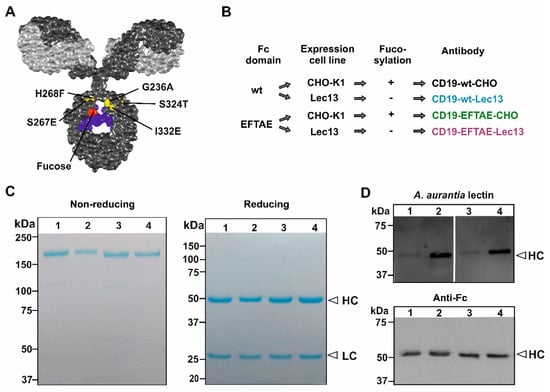
Background: Native cluster of differentiation (CD) 19 targeting antibodies are poorly effective in triggering antibody-dependent cell-mediated cytotoxicity (ADCC) and complement-dependent cytotoxicity (CDC), which are crucial effector functions of therapeutic antibodies in cancer immunotherapy. Both functions can be enhanced by engineering the antibody's Fc region by altering the amino acid sequence (Fc protein-engineering) or the Fc-linked glycan (Fc glyco-engineering). We hypothesized that combining Fc glyco-engineering with Fc protein-engineering will rescue ADCC and CDC in CD19 antibodies. Results: Four versions of a CD19 antibody based on tafasitamab's V-regions were generated: a native IgG1, an Fc protein-engineered version with amino acid exchanges S267E/H268F/S324T/G236A/I332E (EFTAE modification) to enhance CDC, and afucosylated, Fc glyco-engineered versions of both to promote ADCC. Irrespective of fucosylation, antibodies carrying the EFTAE modification had enhanced C1q binding and were superior in inducing CDC. In contrast, afucosylated versions exerted an enhanced affinity to Fcγ receptor IIIA and had increased ADCC activity. Of note, the double-engineered antibody harboring the EFTAE modification and lacking fucose triggered both CDC and ADCC more efficiently. Conclusions: Fc glyco-engineering and protein-engineering could be combined to enhance ADCC and CDC in CD19 antibodies and may allow the generation of antibodies with higher therapeutic efficacy by promoting two key functions simultaneously.


View on the web

Dynamic assessment of human sperm DNA damage III: the effect of sperm freezing techniques

Alexandros G.Sfakianakis shared this article with you from Inoreader

Abstract

Among the currently available strategies for sperm freezing, vitrification may be considered as the leading alternative to conventional cryopreservation. Nevertheless, a direct comparison of both techniques with respect to the iatrogenic sperm DNA damage has not been performed yet. As such, this study was focused to assess the static and dynamic behavior of human sperm DNA damage following thawing of cryopreserved or vitrified spermatozoa. Semen samples were obtained from fifty donors with a normal spermiogram, and divided into four aliquots. The first aliquot represented the neat sample. In the second aliquot the seminal plasma was discarded, and the resulting sperm pellet was resuspended in PBS. The third fraction was used for slow freezing and the fourth fraction was subjected to vitrification. Each set of samples was incubated at 37 °C for 24 h and sperm DNA damage (SDF) was assessed using the chromatin-dispersion test following 0 h, 2 h, 4 h and 24 h of incubation. When comparing the rate of DNA fragmentation (r-SDF) at 2 h, significant differences were observed between the PBS group, cryopreserved (p .000) or vitrified semen (p .015). Furthermore, the sperm longevity comparison using Kaplan–Meier survival curves revealed significant differences between cryopreservation and vitrification (p .000). Our data suggest that exposure of spermatozoa to low temperatures, independently of the chosen freezing protocol, leads to a higher susceptibility of sperm DNA towards damage. This damage is nevertheless lower following vitrification in comparison to traditional cryopreservation. As vitrification leads to a smaller proportion of spermatozoa with DNA damage, we may recommend its use in reproductive techniques which rely on a longer sperm survival, such as artificial insemination.

View on the web

Antiganglioside antibodies in Guillain-Barre syndrome associated with SARS-CoV-2 infection

alkiviadis.1961 shared this article with you from Inoreader

12.cover-source.jpg

The pandemic SARS-CoV-2 is dramatically spreading around the world. Patients with COVID-19 typically present with viral pneumonia and resultant life-threatening respiratory complications. Although little information is available regarding the neurological manifestations of COVID-19, there are a few reports that describe Guillain-Barré syndrome (GBS) as an acute presentation of SARS-CoV-2.1 2 Here, we report a new case of COVID-19 initially presenting with acute GBS. On 24 March 2020, a 72-year-old woman arrived at the emergency department of our hospital presenting with lumbar pain, lower limb weakness and paresthesia, which started abruptly and progressed within 2 days (table 1). In the previous 10 days she had fever (Tmax 38.5°C, 101.3°F), anosmia, hypogeusia, dry cough and sore throat lasting for 3 days. Neurological examination disclosed symmetric weakness Medical Research Council (MRC) grade 3/5 in both legs and feet and MRC grade 4/5 in both arms and hands,...

View on the web